Researches
Interference Management
BiCord: Bidirectional Coordination among Coexisting Wireless Devices

Cross-technology interference is a major threat to the dependability of low-power wireless communications. Powerful wireless technologies such as Wi-Fi tend to dominate the RF channel and unintentionally destroy low-power wireless communications from resource-constrained technologies such as ZigBee, leading to severe coexistence issues. To address these issues, existing schemes make ZigBee nodes individually assess the RF channel’s availability or let Wi-Fi appliances blindly reserve the medium for the transmissions of low-power devices. Without a two-way interaction between devices making use of different wireless technologies, these approaches achieve inefficient network performance or work in limited scenarios. In this paper we propose BiCord, a bidirectional coordination scheme in which resource-constrained wireless devices such as ZigBee nodes and powerful Wi-Fi appliances coordinate their activities to increase coexistence and enhance network performance. Specifically, in BiCord, ZigBee nodes directly request channel resources from Wi-Fi devices, who then reserve the channel for ZigBee transmissions on-demand. This interaction continues until the transmission requirement of ZigBee nodes is learned and fulfilled by Wi-Fi devices. This way, BiCord avoids unnecessary channel allocations, maximizes the availability of the spectrum, and minimizes transmission delays. We evaluate BiCord on off-the-shelf Wi-Fi and ZigBee devices. The results show that BiCord increases channel utilization by up to 50.6% and reduces the average transmission delay of ZigBee nodes by 84.2% compared to state-of-the-art approaches. This work appears in ICDCS 2021.
Resources
- Paper: BiCord: Bidirectional Coordination among Coexisting Wireless Devices
- Slides: BiCord Slides
- Source code: BiCord Source code
Interference-aware wireless concurrency
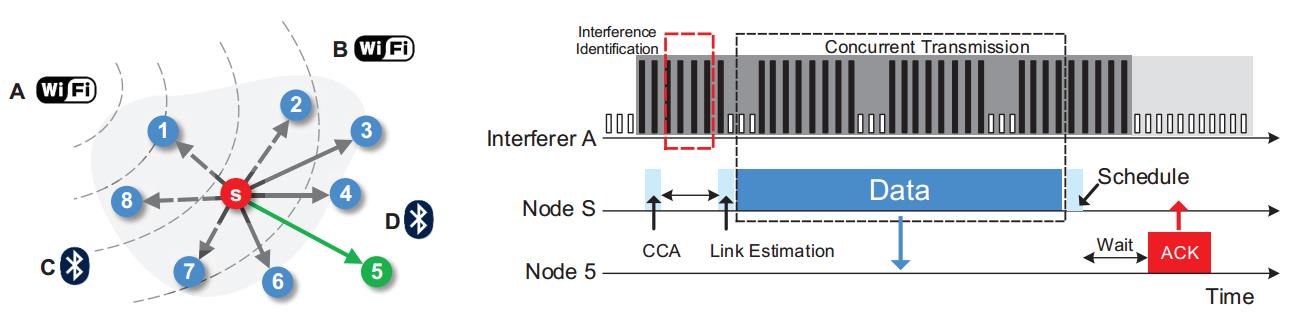
Intelligent utilization of the spectrum is critical for ZigBee to survive through the dense wireless network environment. Our design, named Smoggy-Link, enables a ZigBee node to concurrently transmit data under the ongoing interference (such as Wi-Fi and Bluetooth). Realizing the relationship between interference and link quality, Smoggy-Link can use low-cost interference information for effective link selection and transmission schedule. The experiment results under both controlled environment and real-world environment show that Smoggy-Link has consistent improvements in both throughput and packet reception ratio under interference from various interferer types. This work appears in ICNP 2016 and TMC.
Resources
ZiSense
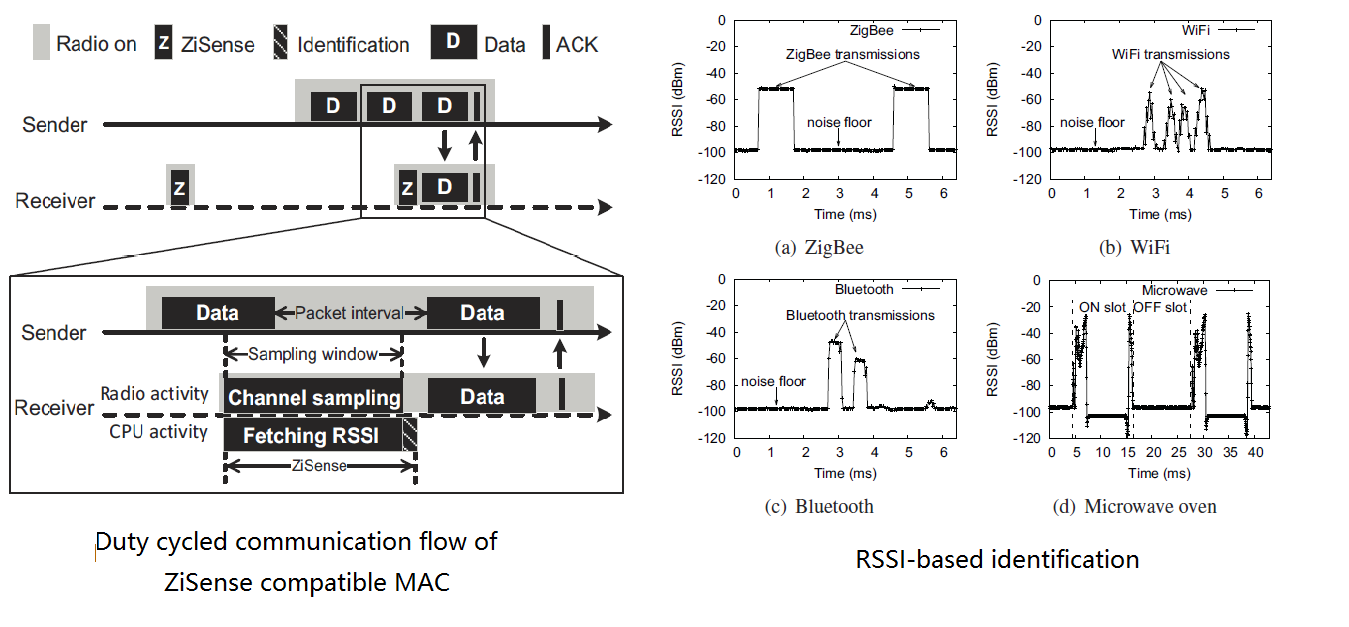
To save energy, wireless sensor networks often run in a low duty cycle mode, where the radios of sensor nodes are scheduled between ON and OFF states. For nodes to communicate with each other, Low Power Listening (LPL) and Low Power Probing (LPP) are two types of rendezvous mechanisms. Nodes with LPL or LPP rely on signal strength or probe packets to detect potential transmissions, and then keep the radio-on for communications. Unfortunately, in coexisting environments, signal strength and probe packets are susceptible to interference, resulting in undesirable radio on time when the signal strength of interference is above a threshold or a probe packet is interfered. To address the issue, we propose ZiSense, an energy efficient rendezvous mechanism which is resilient to interference. Instead of checking the signal strength or decoding the probe packets, ZiSense detects the existence of ZigBee transmissions and wakes up nodes accordingly. On sensor nodes with limited information and resource, we carefully study and extract short-term features purely from the time-domain RSSI sequence, and design a rule-based approach to efficiently identify the existence of ZigBee. Based on accurate identification, ZiSense is able to wake up nodes only when there is valid ZigBee transmission on the channel and therefore avoid the false wakeups.