Researches
Material Sensing
Wireless Sensing for Material Identification: A Survey
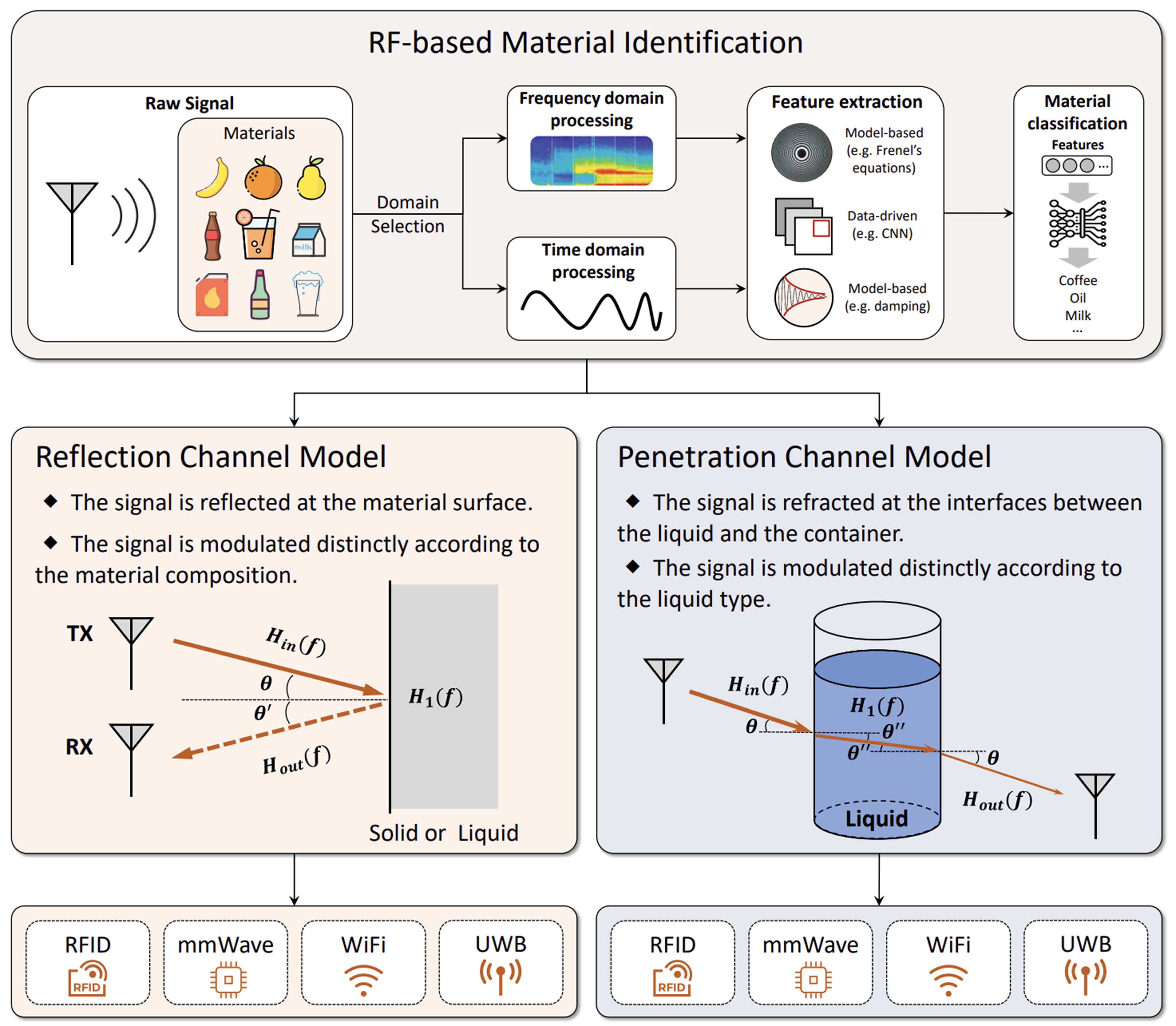
Wireless sensing has been developing rapidly and has supported applications including object localization, tracking and vital sign monitoring. With the availability of fine-grained data such as Wi-Fi channel state information (CSI) and millimeter wave in-phase/quadrature (I/Q) data in recent years, those spatial properties of objects can be measured more precisely. However, the fact that fine-grained data potentially convey more properties of objects (e.g. the material composition) is commonly overlooked. Research on RF-based material identification is essential to explore for a deeper understanding of the interplay between the material and the signal propagation. On one side, the material composition of the reflector (see the left part of the figure below) and the medium (see the right part) influence the signal; on the other side, understanding and designing the material in communication channels can potentially enhance wireless communication. Moreover, material identification enables novel applications in various domains, including industrial quality control, health monitoring and food security.
In this context, the paper titled “Wireless Sensing for Material Identification: A Survey” provides a comprehensive review of the model, technique and performance of material identification. As shown in the figure below, the paper starts with the workflow and taxonomy of material identification, followed by a brief illustration of the reflection-based and penetration-based models. Then, the techniques are grouped by the signal type (i.e. RFID, mmWave, WiFi, UWB) described in detail with specific examples. After that, the advantages and disadvantages of each model and signal type are discussed according to the provided performance metrics of material identification. Finally, the future research directions are outlined.